
Takeaway food container sourcing guide
A takeaway container must be evaluated as part of the meal journey—from filling and closing to holding, transport and final service. Start with that journey before choosing the shape.
Describe the food and portion geometry.
Name the meal or food type, portion volume and whether sauces, separate components or visible presentation are involved. Include the required internal dimensions when the fit of a specific product matters.
A bowl, divided tray, hinged clamshell and folded carton solve different service problems. Choose the format after the portion and packing process are understood.
- Food type and portion
- Target capacity or usable dimensions
- Number of compartments
- Presentation requirement
- Filled-product weight
Map the complete service conditions.
Record filling temperature, expected holding time, transport orientation, storage and any reheating or chilling step. Ask for the selected model to be reviewed against those conditions.
Avoid transferring a performance statement from one material or model to another. The exact construction, closure and intended-use evidence matter.
Compare material families without shortcuts.
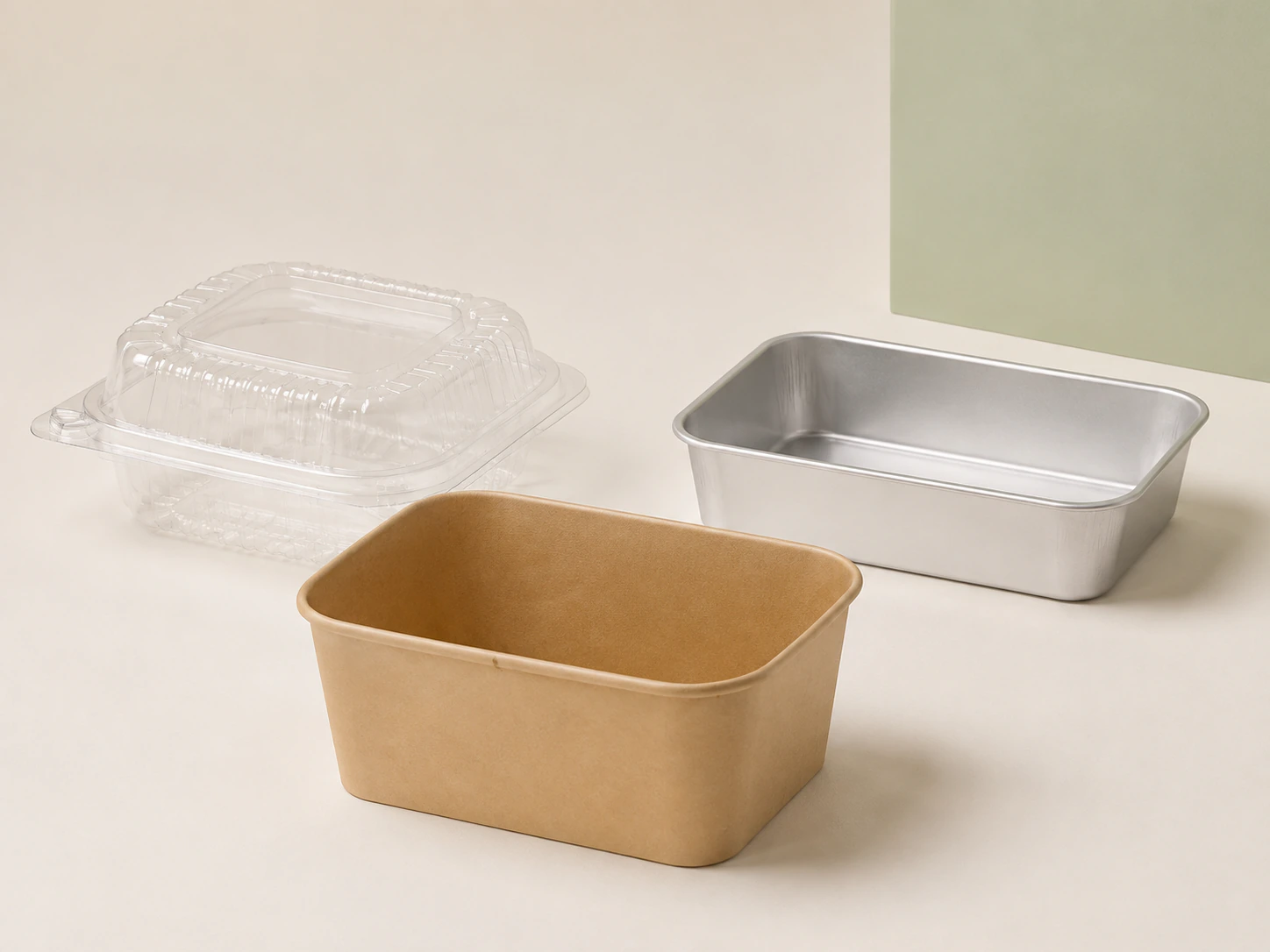
The current range includes molded-fiber, kraft-paper, clear-plastic, PP and aluminium container families. These labels help organize a search, but buyers still need model-level dimensions, construction and use confirmation.
If environmental positioning is part of the program, define the claim, destination market and evidence required. Material appearance alone does not establish recyclability, compostability or local collection outcomes.
Specify the closure and matching parts.
State whether the brief calls for an integrated hinge, folded closure, separate lid or another sealing review. For separate components, record the base and lid references together.
Consider how the container will be filled, closed, stacked and opened. A visual fit should be followed by a model-specific sample and written confirmation.
Include packing and freight inputs.
Confirm pieces per sleeve or bag, packs per case and whether bases and lids are packed separately. Ask for case dimensions and weights when warehouse capacity or freight comparison depends on them.
For a mixed program, list the order quantity by model. A combined piece count can hide important differences in case pack and loading volume.
Create a repeatable sample review.
Test the exact base and closure with the intended food, filling method, holding interval and transport routine. Record observations against the model references rather than a generic product name.
Before ordering, confirm the specification, packing, artwork if any, documents, MOQ, price, availability and lead time in writing for the selected destination.
Common sourcing questions.
- Which information should start a container enquiry?
- Start with the food, portion, temperature, holding and transport conditions, target format or dimensions, closure, quantity and destination.
- Can material alone determine suitability?
- No. Suitability depends on the exact model, construction, closure and intended conditions, supported by the appropriate review and documents.
- Should lids and bases be quoted separately?
- Ask the quotation to identify both references and their packing, even when they are supplied as a matched system.